
A cardboard box maker is a machine (or integrated production system) that converts corrugated cardboard sheets into finished box blanks through processes such as:
– Feeding and alignment
– Creasing / scoring (fold lines)
– Slotting (flap slots)
– Cutting and trimming
– (Optionally) downstream folding, gluing, stitching, depending on the workflow
In short: a cardboard box maker turns corrugated sheets into box blanks that can be folded and packed efficiently—whether you’re shipping e-commerce orders, protecting industrial parts, or handling high-mix warehouse fulfilment.

Why Companies Invest in a Cardboard Box Maker (Real Operational Benefits)
A cardboard box maker is often purchased for one core reason: flexibility. The business benefits show up quickly in day-to-day operations.
Reduce carton inventory (and the space it steals)
Instead of stocking dozens or hundreds of pre-made carton sizes, operations can:
– keep fewer standard sheet formats on hand
– make the needed box size when the order arrives
– reduce warehouse space tied up in packaging inventory
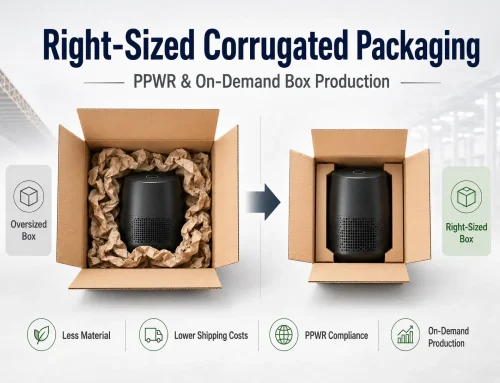
Right-size packaging to cut waste and shipping cost
Right-sized boxes typically lead to:
– less corrugated consumption (smaller blanks)
– less void fill
– better cube utilization
– lower dimensional (volumetric) shipping charges in parcel networks
Handle high-mix, small-batch production without losing time
Traditional box production often assumes longer runs. Modern operations don’t. If your day is made of “Order A: 5 boxes” and “Order B: 12 boxes,” changeover time matters as much as speed.
How Corrugated Cardboard Boxes Are Made (The Core Process)
Most box making follows a consistent set of steps. A cardboard box maker typically supports these key stages:
1) Board selection
Corrugated board is chosen based on:
– required strength and stacking performance
– product weight and fragility
– shipping distance and handling conditions
2) Feeding and positioning
Sheets are fed in and aligned to ensure consistent geometry and repeatability.
3) Creasing (scoring)
Crease lines define where the box folds. Accurate creasing improves:
– squareness
– sealing consistency
– stacking strength (and reduces “ugly folds” that lead to weak cartons)
4) Slotting and cutting
Slots form the flaps; cutting defines the blank shape and trims excess board.
5) Output
Finished blanks are stacked and moved to packing, folding, gluing, or other downstream processes depending on the packaging workflow.
Types of Cardboard Box Maker Machines (And Best-Fit Use Cases)
Not every cardboard box maker is built for the same job. Here’s how the main categories typically map to real operations.
On-demand / custom cardboard box maker (best for high-mix orders)
Designed to produce multiple sizes efficiently, often with extremely fast changeovers.
Best for:
– e-commerce fulfillment
– 3PL and warehousing
– manufacturers packing many SKUs
– short runs and “scattered” small orders
Flexo folder-gluer lines (best for long runs)
Optimized for high-volume standardized cartons, often in large corrugated plants.
Best for:
– long production runs
– repeat box designs
– maximum throughput environments
Die cutting (best for specialty structures)
Used for complex designs and retail-ready packaging requiring tooling.
Best for:
– displays and shelf-ready packaging
– custom shapes and special features
– structured branding needs
What to Look for in a Cardboard Box Maker (Buyer Checklist)
Choosing a cardboard box maker is about matching machine capability to your packaging reality.
1) Changeover time (the hidden ROI driver)
If your operation makes many different box sizes daily, changeover time becomes a major cost.
– For high-mix production, the target is seconds, not minutes.
2) Board thickness and flute range
If you ship anything heavy, fragile, or industrial, board capability is not a “nice to have.” It’s the difference between one machine that covers your full range—and a machine that forces workarounds.
3) Maximum sheet width and length flexibility
Bigger sheets can mean:
– larger boxes
– fewer constraints on design and layout
– more future-proof capacity as packaging needs evolve
4) On-demand sizing capability
On-demand sizing supports:
– right-sizing strategies
– lower packaging inventory
– faster response to changing order profiles
Aopack Cardboard Box Maker: Built for Heavy-Duty Board and High-Mix Orders
Aopack’s approach to “cardboard box maker” is designed around what modern packers actually face: frequent order changes, small batches, and the need to handle both light and heavy-duty corrugated board.
Wide board thickness range: 2–16 mm
Aopack machines can process 2–16 mm cardboard thickness, supporting both standard packaging and heavier-duty requirements.
Supports corrugated from E flute to AAA flute (heavy duty)
From E flute up to AAA flute heavy duty cardboard, Aopack supports a broad range of corrugated structures—helpful for businesses shipping everything from smaller parcel goods to heavier industrial items.
Large format capability: up to 3000 mm max width
With a maximum cardboard width of 3000 mm, Aopack enables large box formats and more flexibility in layout.
No limit on cardboard length
Aopack supports unlimited cardboard length (no length limitation), which is especially useful for oversized packaging and special applications.
Ultra-fast job changeover: 1–6 seconds
For small-batch scattered orders, setup time is everything. Aopack’s 1–6 second order-to-order setup time is built for:
– frequent size changes
– mixed SKU packing lines
– short-run production without productivity collapse
Supports on-demand size production
Aopack supports on-demand sizing, enabling right-sized packaging and reduced carton inventory—especially valuable for fulfillment and warehouse operations.
When an On-Demand Cardboard Box Maker Beats Pre-Made Cartons
Buying pre-made cartons can be perfectly fine when box sizes are stable. But if your business is high-mix, the math changes.
Here’s the practical comparison:
| Option | Best For | Advantages | Limitations |
| Buy pre-made standard boxes | Stable box sizes, predictable demand | Simple, low operational complexity | Inventory bloat, oversized shipping, limited flexibility |
| Buy custom boxes from a supplier | Medium/high volume of repeat designs | High quality, printing options | Lead times, MOQs, less agile for frequent changes |
| Use a cardboard box maker (in-house) | High-mix, fast-changing packaging needs | Right-sizing, fewer SKUs, faster response | Requires equipment, workflow design, operator training |
For businesses producing many box sizes in small quantities, an on-demand cardboard box maker often becomes a competitive advantage: faster packing response, lower shipping cost, and less wasted material.
FAQ: Cardboard Box Maker (Common Buyer Questions)
What does a “cardboard box maker” actually do?
In this context, it refers to a machine or system (often called a corrugated box-making machine or case former) that automates the process of converting flat sheets of corrugated cardboard into folded, and often glued, boxes ready for packing. It performs the key steps of creasing, slotting, cutting, and folding in one integrated workflow.
What”s the main difference between an “on-demand” box maker and a traditional “flexo” line?
The core difference is flexibility vs. volume.
– Traditional Flexo Folder-Gluer: Designed for very long production runs (thousands of identical boxes). Changeovers are slow (minutes to hours) as they require physical tooling (printing plates, crease heads) to be swapped. Ideal for standard, high-volume box sizes.
– On-Demand / Digital Box Maker: Built for short runs and high mix. Changeover between box sizes is instantaneous (seconds) as it”s digitally controlled, with no physical tooling changes. Ideal for businesses that need many different box sizes throughout the day.
Is it really cheaper than buying pre-made boxes?
It”s a shift from a per-box cost to a total cost of ownership model. While the cost-per-blank from an on-demand maker includes machine amortization, labor, and board, it eliminates other significant costs:
– Reduced Material Waste: Right-sizing cuts corrugated usage and void fill.
– Lower Shipping Costs: Smaller boxes often mean lower dimensional weight charges from carriers.
– Eliminated Inventory Costs: No capital tied up in pre-made carton inventory and no storage space required.
For operations with high variability, the total savings in shipping, materials, and warehouse space typically deliver a strong ROI.
Can it handle specialty boxes, like die-cut or retail-ready displays?
Standard crease-slot-cut box makers are optimized for Regular Slotted Cartons (RSC) and similar common styles. For complex shapes, intricate cuts, or specially designed retail displays, a die-cutting process (often a separate machine) is still required. However, many on-demand makers excel at producing the majority of a business”s daily shipping box needs efficiently.
How difficult is it to operate and maintain?
Modern machines are designed with operator-friendliness in mind. They feature intuitive touchscreen interfaces where operators select box sizes from a digital library. Maintenance primarily involves regular cleaning, lubrication, and blade changes, which are straightforward procedures outlined in the manual. Training for basic operation is typically measured in hours, not days.
What is the typical ROI (Return on Investment) period?
This varies greatly based on volume, mix, and current packaging costs. Businesses that ship a high mix of products and are currently paying high costs for multiple pre-made box sizes, excess dunnage, and dimensional shipping premiums often see an ROI in 12 to 24 months. The key drivers are reductions in corrugated waste, void fill, and shipping expenses.
Does it integrate with our existing Warehouse Management System (WMS) or packing software?
Most advanced box makers offer software integration capabilities. They can connect via APIs to receive size instructions directly from a WMS, ERP, or packing optimization software. This creates a seamless “box-on-demand” workflow: the system determines the optimal box size for an order, and the machine produces it instantly at the pack station.
Is an on-demand box maker right for my business?
Ask these questions:
– Do you stock more than 10-15 different box sizes?
– Do you frequently have to use a box that”s too large for the product?
– Is your order profile highly variable (many SKUs, different sizes each day)?
– Are dimensional (volumetric) shipping charges a significant cost?
– Do you lack space for pallets of pre-made boxes?
If you answered “yes” to several of these, an on-demand cardboard box maker is likely a strategic fit that can drive significant efficiency and cost savings.

Leave A Comment