
In the competitive landscape of packaging production, choosing the right box making machine is a critical decision that directly impacts operational efficiency, production costs, and market responsiveness. For businesses seeking to optimize their corrugated cardboard box manufacturing processes, understanding the efficiency differences between advanced solutions like Aopack Box Making Machines and conventional Traditional Folder-Gluers is essential. This comprehensive comparison delves into key efficiency metrics—speed, throughput, flexibility, setup time, and long-term cost-effectiveness—to help you determine which box making machine aligns with your production needs.
Efficiency in box making machine operations is not merely about speed; it encompasses the ability to adapt to varying production demands, minimize downtime, and maximize resource utilization. As packaging requirements evolve—driven by e-commerce growth, customized branding needs, and fluctuating order volumes—modern box making machine solutions must balance consistency with versatility. Below, we break down how Aopack Box Making Machines and Traditional Folder-Gluers perform across these critical efficiency parameters.
1. Speed & Throughput: Balancing Volume and Agility
Throughput is a cornerstone of box making machine efficiency, as it directly translates to output capacity and order fulfillment speed. The performance of each machine type varies significantly based on their design and intended production volume.
Aopack Box Making Machines: Precision and Speed for Low-to-Medium Volumes
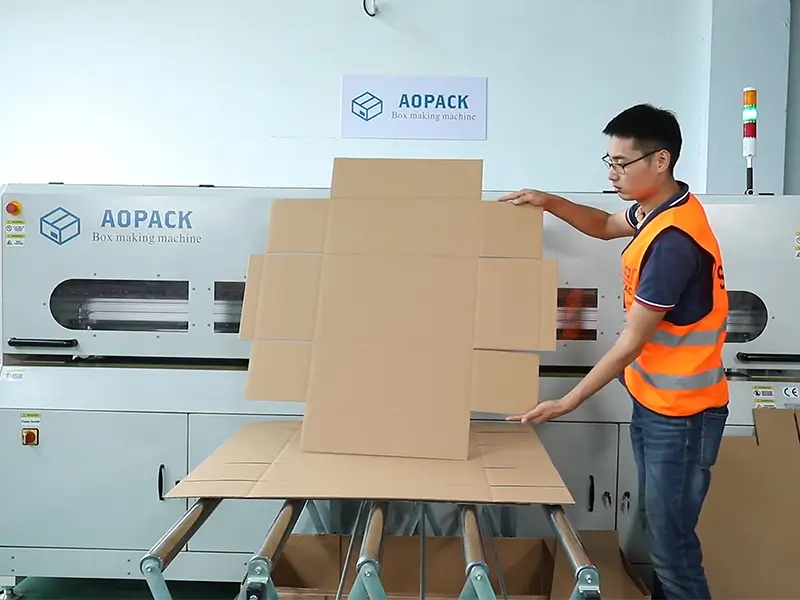
Aopack Box Making Machines are engineered to deliver optimal speed and throughput for low-to-medium volume corrugated box production. Equipped with advanced automated feeding and alignment systems, these machines eliminate manual bottlenecks that often slow down traditional box making machine operations. The integration of independent motor control for slotting, slitting, and creasing tools ensures precise, simultaneous processing, further boosting throughput.
What sets Aopack apart is its ability to maintain consistent speed even when switching between different box sizes or styles. Unlike conventional machines that sacrifice speed for flexibility, Aopack’s automated systems ensure that on-demand production runs—whether for small batches or custom orders—are completed efficiently, making it a top choice for businesses with dynamic order profiles, such as e-commerce retailers and specialized product manufacturers.
Traditional Folder-Gluers: High Volume Focus with Trade-Offs in Flexibility
Traditional Folder-Gluers are designed for high-volume, continuous production, which makes them a staple in large-scale packaging facilities. When operating at full capacity with standardized box designs, these machines can deliver impressive throughput. However, their efficiency is heavily dependent on production consistency—any deviation from the standard requires manual adjustments, which can significantly reduce speed.
Most Traditional Folder-Gluers lack the advanced automation of Aopack’s box making machine solutions. Manual feeding, alignment checks, and tool adjustments add time to each production run, particularly for complex box designs or small-batch orders. While fully automated Traditional Folder-Gluers exist, they come with a higher price tag and still struggle to match the agility of Aopack when it comes to frequent order changes.
2. Setup Time & Changeover Efficiency: Minimizing Downtime
Downtime due to setup and changeover is a major efficiency drain for any box making machine. The ability to quickly switch between box sizes, styles, or designs is a key differentiator, especially for businesses handling multiple orders daily.
Aopack Box Making Machines: Near-Instant Changeovers
Aopack Box Making Machines redefine setup efficiency for box making machine operations. With a user-friendly HMI (Human-Machine Interface) and pre-programmed settings for common box styles (including FEFCO standards), switch-over time from one size or style to another can be less than a minute. This eliminates the long downtime associated with traditional machines, allowing businesses to handle more orders in less time and respond quickly to urgent customer requests.
The automated tool positioning and parameter adjustment features mean that minimal operator training is required to perform changeovers, further reducing the risk of errors and delays. For businesses prioritizing on-demand production, this setup efficiency is a game-changer, turning small-batch and custom orders into profitable opportunities rather than operational headaches.
Traditional Folder-Gluers: Lengthy Setup Processes
Traditional Folder-Gluers are notorious for long setup and changeover times. Even with semi-automatic or fully automatic configurations, switching between box styles often requires manual tool changes, alignment adjustments, and test runs to ensure quality. These processes can take hours in some cases, making them inefficient for businesses that need to handle diverse order portfolios.
While automation can reduce setup time for Traditional Folder-Gluers, it comes at a significant cost, and the flexibility still pales in comparison to Aopack’s box making machine solutions. For facilities focused solely on high-volume, standardized production, this trade-off may be acceptable, but for those needing to adapt to changing market demands, the downtime becomes a critical inefficiency.
3. Flexibility & Customization: Adapting to Modern Packaging Needs
Modern packaging demands are increasingly focused on customization, with businesses seeking unique box designs to enhance brand identity and protect specialized products. A box making machine’s flexibility to handle customizations without sacrificing efficiency is now a key efficiency metric.
Aopack Box Making Machines: Versatility for Custom and Standard Runs
Aopack Box Making Machines are built for maximum flexibility, making them the ideal box making machine for businesses with diverse packaging needs. They can produce any box size and style on demand, from pre-programmed FEFCO styles to fully custom designs. This versatility is achieved without compromising efficiency—custom orders are processed with the same speed and precision as standard runs, thanks to the machine’s integrated multi-process capabilities (cutting, scoring, slotting, and optional printing/gluing).
For e-commerce businesses that need to package products of varying sizes or manufacturers producing specialized goods, this flexibility translates directly to operational efficiency. There’s no need to invest in multiple box making machine solutions or outsource custom packaging—Aopack handles it all in a single, streamlined process.
Traditional Folder-Gluers: Limited to Standardized Production
Traditional Folder-Gluers are primarily suited for standardized box designs. While they can handle some level of customization, complex designs require specialized configurations, which are time-consuming and costly to implement. This lack of flexibility makes them inefficient for businesses that need to produce custom or varied box styles regularly.
In most cases, Traditional Folder-Gluers are part of a larger, fragmented production line that requires separate machines for printing, die-cutting, and assembly. This adds complexity and time to custom orders, further reducing efficiency and increasing the risk of errors or delays between production stages.
4. Long-Term Efficiency: Labor Costs, ROI, and Total Cost of Ownership
True box making machine efficiency extends beyond immediate production metrics to include long-term costs, labor requirements, and return on investment (ROI). A machine that delivers fast throughput but requires excessive labor or maintenance will ultimately be less efficient than a solution that balances speed with cost-effectiveness.
Aopack Box Making Machines: Lower Labor Costs and Fast ROI
Aopack Box Making Machines are highly automated, minimizing the need for manual intervention and reducing labor costs—a key driver of long-term efficiency. The simple HMI interface means that operators require minimal training, reducing hiring and onboarding expenses. Additionally, the integration of multiple processes into a single machine eliminates the need for multiple operators across different production stages.
While Aopack’s initial investment may be significant, the labor and material savings (from reduced waste due to precise processing) result in a quick ROI. For businesses with on-demand or custom production needs, the ability to handle more orders with fewer resources makes Aopack a cost-effective box making machine solution over time.
Traditional Folder-Gluers: Variable Labor Costs and Higher Long-Term Expenses
Traditional Folder-Gluers have variable labor requirements based on their automation level. Manual and semi-automatic models require intensive labor and training, increasing long-term operational costs. Even fully automatic models, while reducing labor needs, often require specialized technicians to maintain and operate, adding to overhead.
The fragmented production line associated with Traditional Folder-Gluers also increases the total cost of ownership. Separate machines for printing, die-cutting, and assembly require more floor space, higher maintenance costs, and additional inventory for spare parts. While fully automatic Traditional Folder-Gluers can deliver high-volume efficiency, their high initial cost and ongoing expenses make them less accessible for small-to-medium businesses.
Conclusion: Choosing the Right Box Making Machine for Maximum Efficiency
When comparing Aopack Box Making Machines vs. Traditional Folder-Gluers, the definition of “efficiency” depends on your business’s specific needs. Aopack’s box making machine solutions excel in flexible, on-demand production environments, delivering superior efficiency through fast setup times, versatile customization capabilities, and lower labor costs. They are the ideal choice for e-commerce businesses, small-to-medium manufacturers, and any operation with diverse or fluctuating packaging needs.
Traditional Folder-Gluers, on the other hand, remain efficient for high-volume, standardized production, where economies of scale justify their longer setup times and higher labor requirements. For large-scale facilities producing consistent box styles in massive quantities, they can deliver strong throughput—though they lack the agility needed to adapt to modern packaging demands.
Ultimately, the most efficient box making machine is the one that aligns with your production volume, customization needs, and budget. By prioritizing the efficiency metrics that matter most to your operation—whether speed, flexibility, or long-term cost-effectiveness—you can select a solution that drives productivity, reduces costs, and keeps your business competitive in the evolving packaging landscape.
Leave A Comment