
Welcome to this article, which is an in-depth guide to flute laminator, Before you buy a new flute laminator, check out our guide that covers everything you should consider to find the best machine for you.
1. What is a flute laminator?
The automatic flute and groove laminating machine is mainly used for laminating the liner to the flute groove of corrugated cardboard or laminating one cardboard to another with adhesive. Suitable corrugated flute styles include A, B, C, E, and F flutes.
This trough laminating machine is designed with an automatic suction system for the top liner and bottom corrugated board. Ideal for producing high-end packaging boxes.
2. What are the features of the flute laminator?
There are some features below:
- Automatically feed the bottom paper and push the front paper on the front side, with fast paper feeding and low work intensity.
- The positioning bottom does not exceed, which is suitable for the lamination of cardboard, and also for the lamination of cardboard and A/B/C/D/E corrugated cardboard.
- Bottom paper and face paper can be pre-adjusted and artistically, easy to laminate together.
- The gluing system is automatically controlled by a liquid relay, and the gluing thickness is adjustable. The gluing is uniform and the gluing cost is low.
- Control panel, electromagnetic clutch non-contact relay, position monitored by the photoelectric switch, digital automatic counter.
- High-precision lamination, the finished surface has smooth edges and high strength.
- The whole machine has a compact structure, a beautiful appearance, and high work efficiency.
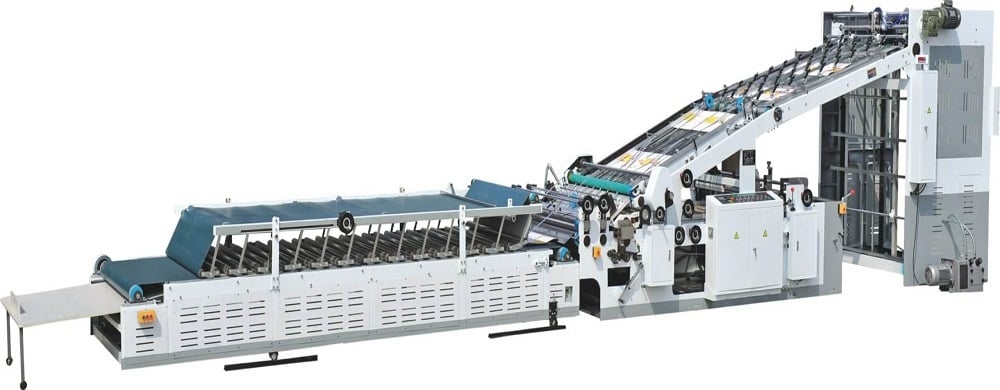
3. What are the characteristics of the high-speed trough laminating machine?
Main features:
- Computer high-speed lamination speed can reach 150m/min. It depends on the quality of the sheets.
- The E-type lifting plate is used for the feeding device so that the plate is pushed into place by the hydraulic jack. Rails with pre-piling devices are available as an option.
- The high-strength feeder ensures high-speed operation without missing pieces.
- The sensor compensation centering device uses multiple sets of sensors to sense the relative position of the running corrugated board so that the two servo motors on the left and right sides of the top paper are independently driven to achieve high-precision and high-speed centering of the top paper and the corrugated board.
- The full-function electronic control system, touch screen, and PLC program automatically monitor the working status, which is convenient for troubleshooting. Electrical design conforms to CE standards.
- The gluing device adopts a high-precision gluing wheel and cooperates with a specially designed metering roller to improve the uniformity of gluing. Unique glue wheel, with glue stop device, and automatic glue level control system, to ensure that the glue does not overflow.
- The frame is processed by a CNC lathe at one time, which ensures the accuracy of each position. Gear transmission, smooth operation, and low noise. The motors and spare parts are made by Chinese famous brands, with high efficiency, less trouble, and long service life.
- The corrugated board feeding unit adopts a powerful servo motor control system, which has the characteristics of high sensitivity and high speed. The paper suction device adopts a high-pressure blower, SMC large flow control valve, and unique dust filter box, which enhances the suction force of different corrugated paper and ensures smooth operation, no double sheets, multiple sheets, and no missing sheets.
- Automatic glue supply system: This machine adopts an imported liquid level controller to supply glue. When the amount of glue is insufficient, the paper feeder can be automatically stopped to avoid wasting paper.
4. What is the use of the flute laminator?
The main advantage of using a laminator is to protect and improve the quality of the material being laminated. Laminate adds a layer of clear plastic that protects the laminate from smudges, stains, and liquids.
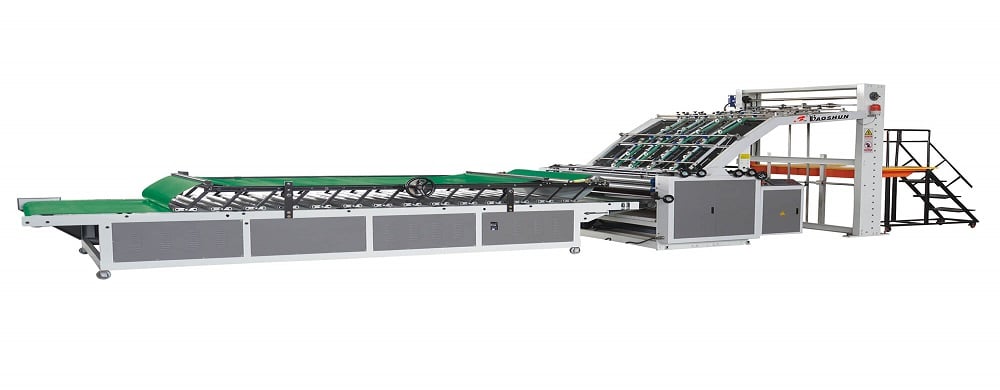
5. What are the factors for choosing a flute laminator?
There are some factors bout choose a flute laminator:
1) Document size
Think about the files you want to overlay. Are they all standard sizes? Or will you be laminating a range of sizes, from business cards to banners?
A bag press is a great option if you primarily laminate standard-size documents. You can also pack several small items in a foil bag. If you need a more flexible option, a roller press may be your best bet. Our roll laminators cover a wide variety of document widths, from 9″ to 27″. The automatic tablet press is ideal for standard-size files, but can also tablet small projects and files up to 11″ x 17″.
2) Number of pages
Consider the frequency of your tableting and the number of documents you will be running at one time. If you film small projects once or twice a week, a bag filmer is perfect for you. If you are going to laminate a lot of large files or odd shapes, a roll laminator will be your best bet. Automatic laminators are great for large lamination jobs with standard-sized documents and those that are laminated several times a week.
3) Film thickness
The composite film is measured in milliliters, and the larger the number of milliliters, the thicker the laminate. Smaller mils maintain more flexibility, while larger mils are rigid.
Bag laminators can range from 3mm-10mm, which gives you a wide choice of thicknesses. Roll laminators typically run 1.5 mil-3 mil films. Automatic laminators are capable of running 3 mil and 5 mil film cartridges, making them a good choice for standard projects.
4) Number of users
The number of people using the machine is a major factor to consider when choosing a laminator. Will it be used by a large team, or are you the only user?
Pouch machines are small and fit on your desktop, making them perfect for personal use. If you have multiple users, a roll laminator is a good choice. These machines are larger and can be set up in a shared workspace for everyone to use. Automatic laminators are versatile and suitable for personal or shared use. An automatic setup makes it easy to switch from one user to the next.
5) Cost
Remember, a laminator is an investment. You need to consider not only the cost of the laminator but also the cost of the film supply. No matter what laminator you are looking for, we offer a wide range of machines and supplies to suit almost any budget.
Whether you’re buying your first laminator or looking for an upgrade, it’s important to keep these factors in mind. If you know which features are most important to your needs, you can easily find the right machine for you.
Leave A Comment